



SHAPE-THE-LIGHT project is co-funded by the Creative Europe Programme – CREA-CULT-2023-COOP – Grant Agreement 101131736
Business, innovation and creativity are interrelated. SHAPE-THE-LIGHT is based on the dual complementary concept of the intrinsic relationships between art and business, focusing on art, design and the lighting industry.
SHAPE-THE-LIGHT project aims at implementing initiatives and an open and inclusive collaborative space for the creation of new creative processes, business models and market developments, and to embrace the digital and ecological transition in the architectural lighting design sector.
The project, with a total duration of 30 months, started on 8 January 2024 and was completed on 7 July 2026.
The main objective was to create a bridge between the different agents in order to generate co-creation and co-design processes, launching opportunities to test advanced technologies and new innovative solutions to the challenges posed for these industries. These support measures and collaborative spaces triggered the creation of new creative processes and business models, driving the development of the lighting sector towards the proposals put forward in the European Green Deal and the priorities of the New European Bauhaus.
SHAPE-THE-LIGHT priorities
- Sustainability. In line with the European Green Pact and the New European Bauhaus, co-create, adopt and disseminate more environmentally friendly practices, as well as raise awareness of sustainable development through cultural activities;
- Digitalisation. To support the European cultural and creative sectors in their digital transition and business recovery after the COVID-19 crisis.
- Inclusion. From valuing diversity and equality for all, to ensuring accessibility and consideration for all needs.
SHAPE-THE-LIGHT project contributed actively to the objectives of the European Green Pact and the transition towards a sustainable and digital society by providing tangible opportunities and experiences, both at local and European level, for creation, co-design, experimentation, knowledge sharing and networking. Among the activities planned to achieve the objectives presented in the proposal, during the 30 months of the project, we found performance labs, coffees, masterclasses, workshops and forums, among others.

Co-funded by the European Union. Views and opinions expressed are however those of the author(s) only and do not necessarily reflect those of the European Union or EACEA Agency. Neither the European Union nor the granting authority can be held responsible for them.
SHAPE-THE-LIGHT CONSORTIUM:
1. Rete di Imprese Luce in Veneto, IT (Project Coordinator)
2. CICAT Lighting Cluster , ES
3. Cluster Lumière , FR
4. Catholic University of Leuven , BE

SHAPE-THE-LIGHT INTERNATIONAL MASTERCLASSES
The SHAPE-THE-LIGHT Capacity Building Academy was designed to address the training needs, knowledge gaps, and challenges faced by key stakeholders (lighting SMEs, artists, students, lighting designers, architects, designers). These challenges stemmed from the digitalisation of processes, the disruption caused by advanced technologies, and the growing need to raise awareness about the importance of more sustainable, circular, and inclusive design approaches in lighting products, solutions, and artistic creations.
The SHAPE-THE-LIGHT Capacity Building Academy was structured around two key learning and knowledge-sharing formats:
- International Masterclasses – these were online, classroom training workshops, open to the project’s target stakeholders across the EU and beyond, held in English by qualified experts.
- Local Deep-Dive Workshops – these sessions aimed to explore in greater detail the topics identified as most relevant during the masterclasses, delivered in local languages in the four project countries (Italy, Spain, France, Belgium).
Four International online classroom-based Masterclasses were delivered:
-
Masterclass 1 – Sustainability of Artistic Lighting Products, coordinated by KUL
-
Masterclass 2 – Sustainability of Artistic Lighting Performances, coordinated by CICAT
-
Masterclass 3 – Digitalization of Artistic Lighting Products, coordinated by LIV
-
Masterclass 4 – Digitalization of Artistic Lighting Performances, coordinated by Cluster Lumière
INTERNATIONAL ONLINE MASTERCLASS 1
Sustainability of artistic lighting products
KU Leuven and Cluster Groen Licht Vlaanderen delivered the first international masterclass organized within the SHAPE-THE-LIGHT project.
The masterclass was related to the introduction of the sustainability principles on (artistic) lighting products. The subject was about the application of the actual and new Eco-design rules in the design of (artistic) lighting products to make the products sustainable, and to boost circular business in line with the European Green Deal and the New European Bauhaus strategies.
Date: Tuesday 16/09/2025 1.30 – 5.30 PM (CET)
Programme:
Masterclass ‘Sustainability of artistic lighting products’ by Teresa Selvaggio (LightingEurope)
- Current and future Ecodesign and Labelling rules for lighting – a focus on circularity
- Sustainability-related legislative files impacting the lighting industry
Interactive showcasing by Greet Verhoeven (Etap Lighting International)
Q+A
INTERNATIONAL ONLINE MASTERCLASS 2
Sustainability of Artistic Lighting Performances
The second International Masterclass, Sustainability of Artistic Lighting Performance was coordinated by Clúster d’il luminación de Catalunya and organised within the SHAPE-THE-LIGHT project.
The masterclass addressed sustainability principles in artistic lighting performance, focusing on Light Art as artistic language, light pollution and ethical responsibility, sustainable urban light installations, public-space value creation, and cross-sector collaboration for a new culture of sustainable light.
Date: Wednesday 25/03/2026 2.45 – 6.40 PM (CET)
Programme:
- ‘Light Art: Theory, Language, and Message.’ by Sophya Acosta – Sophya Acosta Lighting Design Studio / Light.Lab
- ‘Light Art Showcase: Projects, Processes, and Learnings.’ by Maurici Ginés – Artec Studio
- ‘Light Pollution: Science, Ethics, and Creative Responsibility.’ by Chiara Carucci – Noctua
INTERNATIONAL ONLINE MASTERCLASS 3
Digitalization of Artistic Lighting Performances
The 3rd international masterclass, Digitalization of Artistic Lighting Performances, was coordinated by Cluster Lumière and organized within the SHAPE-THE-LIGHT project.
This masterclass, led by Prof. Dr. Marc Fontoynont (President of Light & Innovation SAS) provided inspiration, methods, and hands-on tools to elevate professional projects and explained how digital technologies, interactive storytelling, and citizen involvement can transform lighting performances into powerful emotional and social experiences.
These sessions combined live demonstrations, virtual simulations, and guided experimentation to translate creative ideas into digital reality through play, interaction, and user engagement.
Date: Wednesday 14/01/2026
Key Insight Topics Covered:
- Artificial intelligence in lighting design and adaptive systems
- Shared and networked interactive lighting experiences
- Virtual light shows, pre-visualization, and digital twins
- Smart lighting materials
- Sustainable, modular, and future-proof lighting design
INTERNATIONAL ONLINE MASTERCLASS 4
Digitalization of Artistic Lighting Products
Organised within the SHAPE-THE-LIGHT project, this 4th international Masterclass was dedicated to lighting, design and innovation professionals interested in exploring how advanced digital technologies are transforming the conception, design and production of artistic lighting products.
Delivered by LIV, the session focused on the digital frontiers of lighting design, combining AI, XR, IoT and additive manufacturing through practical insights, methodologies and real-world applications. The Masterclass also featured a selection of artistic lighting products developed by students of SID – Italian Design School, illustrating the complete design process from initial inspiration to final manufacturing, with particular attention to the use of digital tools.
Date: Thursday 12/02/2026 2.00 – 5.00 PM (CET)
The Masterclass was shared in 2 sessions:
- “Technology Insight: IoT, Wireless & Wired Communication for Lighting” with contributions from Drosihn Paul, general manager DALI Alliance, Barbisan Diego, IUAV University of Venice, and Azzarello Andrea, CASAMBI Technologies
- “Immersive Design & Prototyping” with contributions from Rizzo Matteo, MIRAI SRL, Trombin Luca, SID Italian Design School, and Dalla Villa Roberto, CEO Skeinholding Srl.
SHAPE-THE-LIGHT NEWS
SHAPE-THE-LIGHT NETWORKING SESSIONS
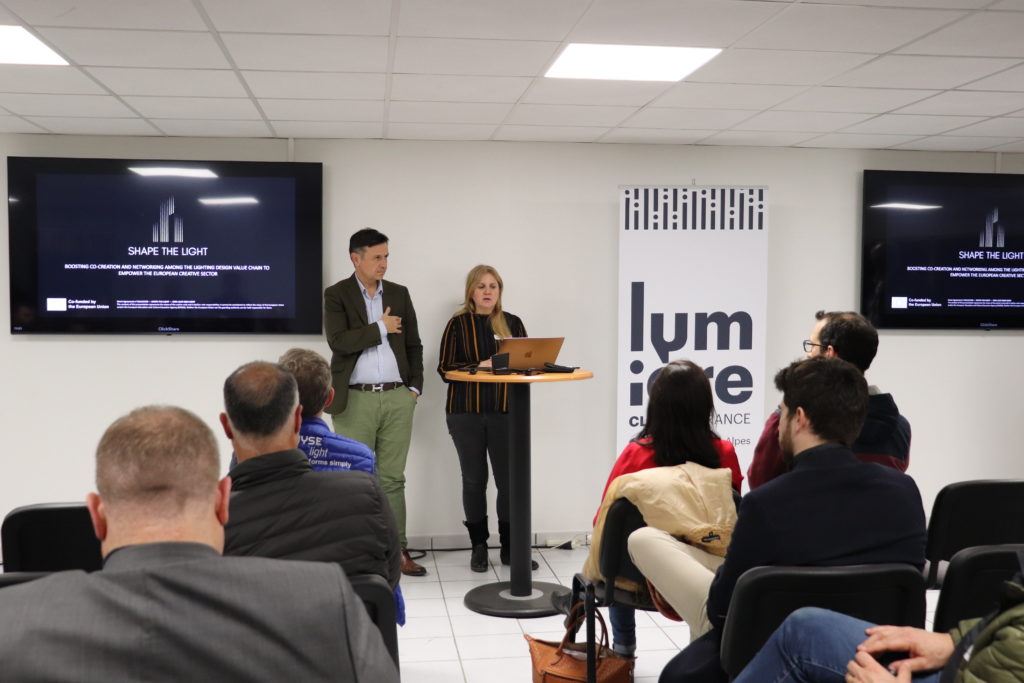
Throughout the initial months, our partners organized networking and informative sessions to introduce the SHAPE-THE-LIGHT project and its objectives to various stakeholders, such as lighting companies, artists, designers, students and graduates of the Art, Design and Architecture specialisation courses of Academia and technical institutes and cultural associations, and to emphasize the upcoming activities and workshops aimed at fostering the development of new creative processes, business models, and market advancements within the architectural lighting design sector.
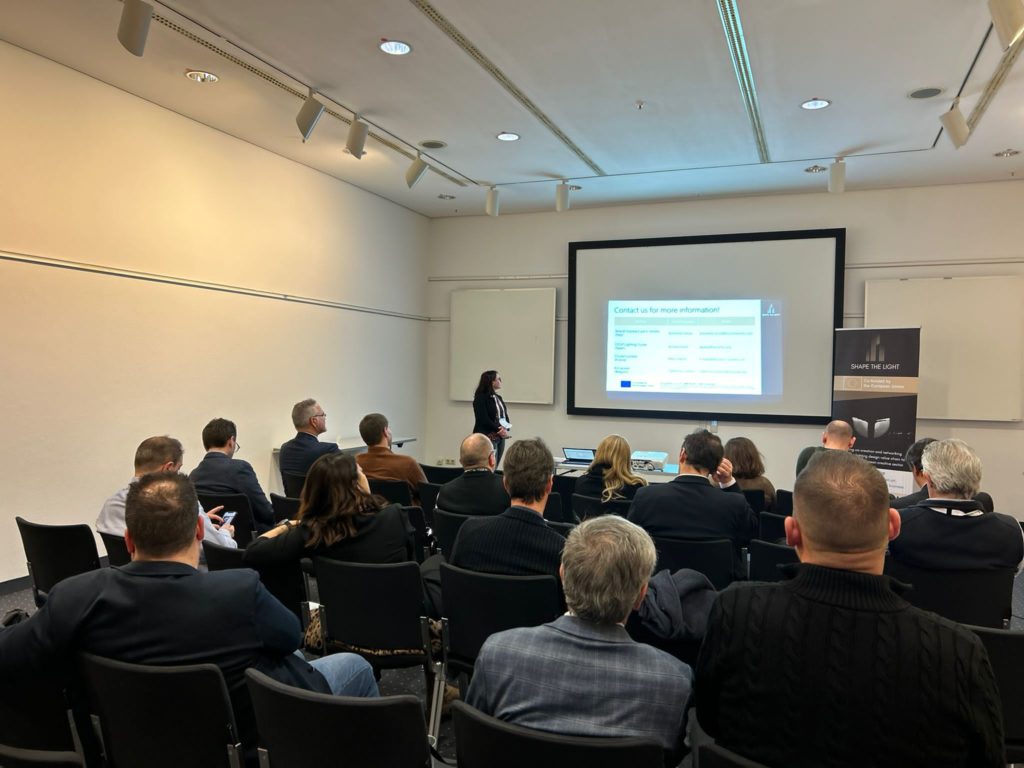
- SHAPE-THE-LIGHT Kick-Off session in Frankfurt (05.03.2024)
Presentation of SHAPE-THE-LIGHT project, its objectives and activities during the Light+Building Fair in Frankfurt, Germany on 05.03.2024.
- Presentation of SHAPE-THE-LIGHT project during the Lichtfestival Gent (02/02/2024)
Presentation of SHAPE-THE-LIGHT project on networking event at the ‘Lichtfestival Gent by day’, organized by the city of Ghent on 02/02/2024 during the Gent Lichtfestival. The audience consisted of artists exhibiting at the Light festival, other cities (members of ILO International Light Festivals Organisation), SME members of Groen Licht Vlaanderen, and other stakeholders.
- Networking event at Light AfterWork SOPEMEA (14.03.2024)
Cluster Lumière organized a networking event in Lyon that started with a presentation of new members and new projects, including the SHAPE-THE-LIGHT project.

SHAPE-THE-LIGHT LOCAL DEEP DIVE WORKSHOP
Local Deep-Dive Workshops were one of the two key learning and knowledge-sharing formats within the SHAPE-THE-LIGHT Capacity Building Academy, alongside the International Masterclasses.
These sessions, delivered in local languages, aimed to explore in greater detail the topics identified as most relevant during the masterclasses and allowed stakeholders to elaborate more on specific arguments, without language barriers, and carry out more intensive know-how sharing and interchange between experts, practitioners and learners.
Four Local Deep Dive Workshops were delivered:
-
Deep Dive Workshop 1 – The Beautification of internal and external architectural spaces, coordinated by LIV
-
Deep Dive Workshop 2 – Digital Lighting for Festivals, coordinated by Cluster Lumière
-
Deep Dive Workshop 3 – Walk on the Lightscape, coordinated by CICAT
-
Deep Dive Workshop 4 – EU Ecodesign, Circularity, Right to repair, Product passport, EPREL for lighting, coordinated by KUL
SHAPE-THE-LIGHT DEEP DIVE WORKSHOPS IN ITALY!
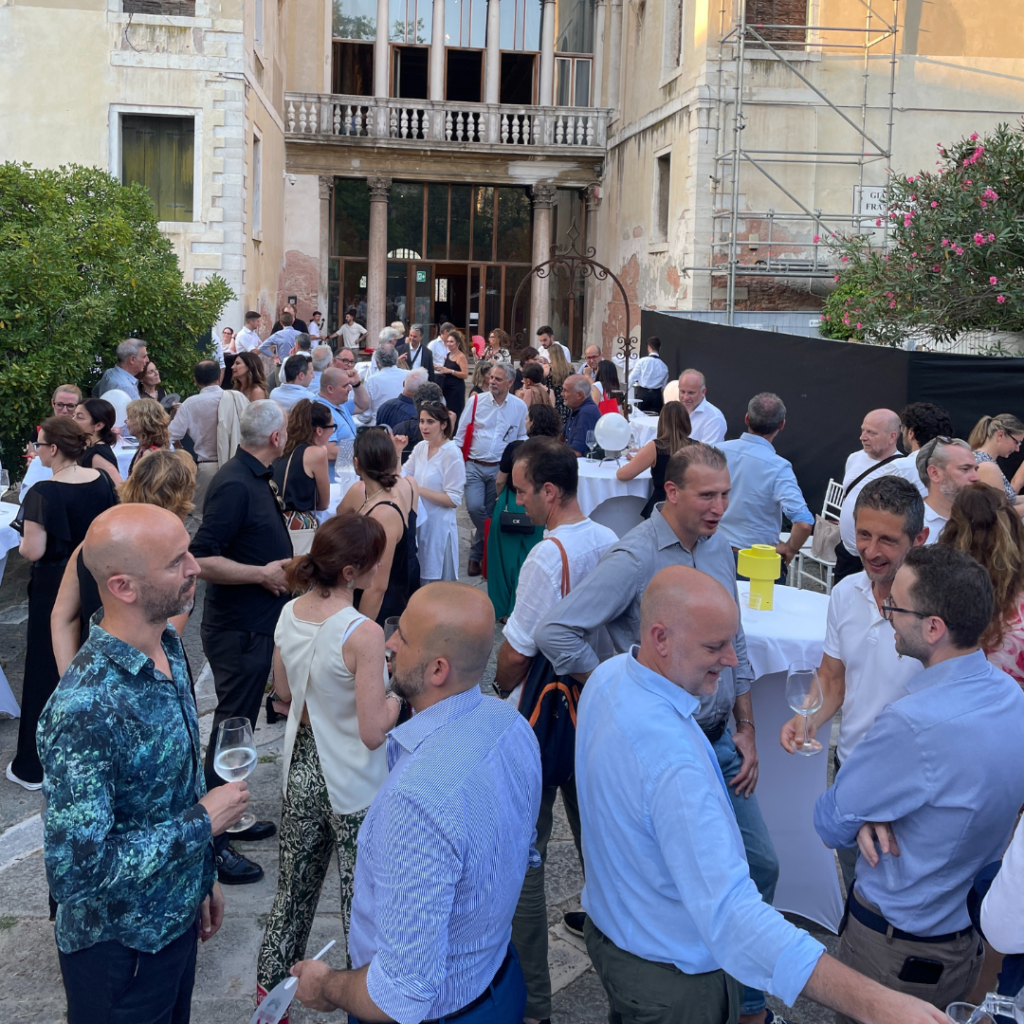
Great success for the SHAPETHELIGHT Deep Dive Workshop “La beautification degli spazi architettonici interni ed esterni” organized by Rete di Imprese Luce in Veneto, with the sponsorship of the Veneto Region and in collaboration with Università Iuav di Venezia, the Order of Architects PPC Venice, and the Foundation of Architects PPC Venice. Over 70 people attended the event, held at Palazzo Cà Tron in Venice on 11.07.2024. Architects, lighting designers, professors, students, artists, and lighting companies had the opportunity to delve into topics on the use of light and the composition of spaces, as well as explore trends in the design sector.
The SHAPETHELIGHT Deep Dive Workshop was structured in two parts:
- ‘Design Trends in Lighting Fixtures’ with the contribution of Prof. Alberto Bassi, IUAV University of Venice
- ‘The role of Lighting Designers in the Artistic Composition of light’ with the contribution of Arch. Bianca Tresoldi, President of APIL (Associazione Professionisti dell’Illuminazione).
The event concluded with a Fireside Chat on the theme “Women in Lighting”, featuring:
- Arch. Carolina De Camillis, lighting designer / AIDI
- Silvia Betteto, ELESI LUCE SRL
- Laura Bellia, Università degli Studi di Napoli Federico II and President of AIDI
- Arch. Francesca Cremasco, lighting designer / AIDI
- Arch. Silvia Codato, Bongiana Architetture
- Dr Antonella Venza, Cluster Manager at Rete di Imprese Luce in Veneto
The roundtable sparked a lively discussion and active audience participation on the role of women in the professional lighting design sector.


SHAPE-THE-LIGHT DEEP DIVE WORKSHOP IN FRANCE
The Deep Dive Workshop “Digital Lighting for Festivals: Tools and Creativity for Immersive Light Art & Digital Tools in Lighting Art” organized by Cluster Lumière took place on 4 December 2025 and was designed for artists, designers, technologists and festival creators interested in exploring the integration of digital technologies into live lighting performances for public festivals in France.
Initially held online and later continued onsite to provide an authentic, real-world experience, the event featured Barbara Coudene, an expert in digital lighting, immersive media and festival innovation. The workshop focused on prototyping, digital storytelling in public spaces and the use of digital tools in lighting art.
During the Deep Dive Workshop, participants explored how emerging digital technologies can be integrated into live lighting performances to create immersive audience experiences for public festivals. The session provided participants with a clearer understanding of how to design interactive lighting environments capable of transforming urban spaces.
The event concluded with a Fireside Chat, an open conversation exploring the role of digital tools in contemporary lighting art. The discussion focused on the evolution of lighting technologies, the ways in which digital tools are reshaping artistic vision, as well as issues related to ethics, sustainability, public engagement and future trends in immersive festival experiences.
SHAPE-THE-LIGHT DEEP DIVE WORKSHOP IN SPAIN
CICAT organized the local deep-dive workshop “Walk on the Lightscape” as an in-person learning activity linked to Llum BCN 2026. The route was guided by Alberto Barberá, lighting designer from Anoche, with the collaboration of Miquel Angel Julià Hierro, Bernadí and CICAT. The activity took place during Llum BCN, Barcelona’s light arts festival, which in 2026 was framed around the theme of nocturnal landscapes and the emotional and experimental relationship between light, architecture and the city.
Unlike a classroom-based format, this deep dive used the city itself as a learning environment. Participants moved through selected installations and urban spaces, observing how light transforms perception, modifies the identity of places, generates collective experience and raises questions about sustainability, technological mediation, visual saturation and the preservation of darkness.
The conceptual framing of the activity was supported by the text “Walk on the Lightscape” by Alberto Barberá and Miquel Angel Julià Hierro, which reflects on the contemporary city as interface, on the transformation of urban perception by audiovisual technologies, and on the need to reclaim a degree of silence and darkness in the nocturnal landscape.
SHAPE-THE-LIGHT DEEP DIVE WORKSHOPS IN BELGIUM!
The SHAPE-THE-LIGHT Local Deep Dive Workshop “EU Ecodesign, Circularity, Right to Repair, Product Passport, EPREL: Regulatory Aspects”, organised by KU Leuven, was held on 30 March 2026 at KU Leuven’s Gent Campus.
The workshop provided an up-to-date and comprehensive overview of European product regulations directly affecting lighting products. It focused on Ecodesign, Energy Labelling, EPREL, reparability and the Right to Repair, as well as the initial framework of the Digital Product Passport.
The Deep Dive Workshop combined regulatory content with practical examples, interpretation exercises conducted via Mentimeter, and key considerations for implementation. Participants gained not only an understanding of what is mandatory, but also, and more importantly, why these rules exist and how they should be applied in conjunction with one another.
The following aspects were discussed with the contribution of the expert in the ICT sector Jacob Nuesink (Litecert, DEKRA):
- The current status of the existing Ecodesign Regulation, the Single Lighting Regulation (SLR), Energy Labelling and EPREL, with a focus on light sources.
- The first ESPR and Energy Labelling Working Plan for energy-related products, with a focus on light sources and, for Ecodesign only, separate control gears.
- Repair information and maintenance requirements, including the availability and delivery times of spare parts and software updates.
- The EU Right to Repair legislation, with particular reference to repair services and their connection with Ecodesign requirements on reparability.
- The EPREL implementing act.
- Circularity.
SHAPE-THE-LIGHT FIRESIDE CHAT
The SHAPETHELIGHT Fireside Chats were Q&A sessions that enhanced direct dialogue between the lighting design creative value chain players in a more informal way, facilitating the networking.
Eight Fireside Chat sessions were delivered across the four project countries, with two sessions held in each country.
SHAPE-THE-LIGHT FIRESIDE CHAT SESSIONS IN ITALY!
The first Fireside Chat session, “Women in the Lighting Industry”, coordinated by LIV, was held on 11 July 2024, following the Local Deep Dive Workshop dedicated to “The Beautification of Internal and External Architectural Spaces”, as part of the European SHAPE-THE-LIGHT project.
The session aimed to discuss the role of women in the professional field of lighting design and engaged five female professionals from different backgrounds in the discussion: Arch. Bianca Tresoldi, President of the APIL Lighting Association; Silvia Betteto, owner of the Elesi Luce company; Laura Bellia, President of AIDI – Italian Lighting Association; Francesca Cremasco, Lighting Designer; Arch. Silvia Codato, owner of an Architetural Studio; and Dr Antonella Venza, Cluster Manager at Rete di Imprese Luce in Veneto.
This Fireside Chat session represented an important moment of reflection and dialogue, highlighting the contribution of female professionals and encouraging a broader discussion on inclusion, representation and leadership in the sector.
On Thursday 10th July 2025 at the venue of historical Villa Cà Marcello in Italy RI LIV hosted the second Firesite chat “The shape of the light” as part of the European project SHAPE-THE-LIGHT.
This second Fireside chat explored how smart technologies—such as IoT and lighting control systems —can be leveraged to develop lighting solutions that are both accessible and artistically expressive.
The conversation brought together lighting designers, creative industry professionals, technology innovators and institutional stakeholders to examine the transformative potential of adaptive lighting systems in enhancing inclusivity and aesthetic quality. The Fireside Chat fostered open dialogue among speakers and encouraged active engagement from the audience. The discussion aimed to bridge technological innovation with artistic design, promoting co-creation and inclusivity in the next generation of lighting products.
SHAPE-THE-LIGHT FIRESIDE CHAT SESSIONS IN FRANCE!
On 4 December 2025, Cluster Lumière organised its first Fireside Chat as part of the SHAPE-THE-LIGHT project, following the Local Deep Dive Workshop “Digital Lighting for Festivals: Tools and Creativity for Immersive Light Art & Digital Tools in Lighting Art.”
The session took the form of an open conversation exploring the role of digital tools in contemporary lighting art. The discussion began with the evolution of lighting technologies, then examined how digital tools are reshaping artistic vision, ethics, sustainability and public engagement, and concluded with a reflection on future trends in immersive festival experiences.
Coordinated by Cluster Lumière, with the contribution of Barbara Coudene, an expert in digital lighting, immersive media and festival innovation, the second Fireside Chat, “Digital Technologies to Reimagine Light as Art”, was held on 23 April 2026.
The session explored how digital technologies are reshaping light as a creative medium. The discussion addressed the growing role of AI in lighting design, the use of virtual and augmented reality to create immersive experiences, and the ways in which interactive installations can engage audiences in new ways. It also highlighted emerging sustainable technologies and the evolving role of light in public spaces, performance and storytelling.
SHAPE-THE-LIGHT FIRESIDE CHAT SESSIONS IN BELGIUM!
This SHAPE-THE-LIGHT Fireside Chat session, “Circularity within the Lighting Value Chain: Aspects of Management and Implementation”, held on 28 January 2026, was the first of two consecutive sessions organised by The Light & Lighting Laboratory (KU Leuven) in collaboration with Cluster Groen Licht Vlaanderen.
Featuring contributions from Lard Vanobbergen (Vlaams Energiebedrijf), Guy Van den Bogaert (Nekton Project), and Tom De Fruytier (Signify), the session focused on how circularity can be implemented across the lighting value chain. The discussion addressed the benefits and opportunities of circular lighting, as well as its main pitfalls and potential shortcomings.
Featuring Thomas Vandenhaute (Sirris) as guest speaker, the second Fireside Chat, “Circularity for Lighting Products: Aspects of Manufacturing,” was held on 5 February 2026.
The session explored key aspects of circularity, additive manufacturing, and new approaches to product assembly and disassembly. Particular attention was given to systems and life-cycle thinking, solution-oriented process management for change projects, and a broad understanding of materials and manufacturing processes.
SHAPE-THE-LIGHT FIRESIDE CHAT SESSIONS IN SPAIN!
The first SHAPE-THE-LIGHT Fireside Chat, “Diversitat Professional d’Arquitectes: Interiorismo, Retail, Escenografía y Diseño de Iluminación,” took place on 5 February 2026.
Organised by CICAT in collaboration with the Demarcació de Barcelona of the Col·legi d’Arquitectes de Catalunya (COAC), the session was dedicated to interior design, retail, scenography and lighting design. It was conceived as a professional dialogue aimed at presenting, in a practical and accessible way, the diversity of specialisations through which architecture is currently practised.
Featuring Sandra Bestraten, Miquel Àngel Julià Hierro, Àfrica Sabé Dausà, Iñigo Gómez Arribillaga, Josep Iglesias Reixach and Mariel Fuentes, the activity focused on how spatial design, and particularly light, narrative and staging, shapes the user experience, influences the understanding of a product or message, and contributes to building trust.
CICAT, EINA and ERCO organised the first session of the cycle Paisatges Lumínics, entitled ‘Quan la llum revela l’arquitectura’, as a local fireside chat and deep-dive activity linked to the SHAPE-THE LIGHT Capacity Building Academy. The session was held on 22 April 2026 at the ERCO showroom in Molins de Rei (Barcelona) and combined expert presentations with a practical mock-up experience, allowing participants to observe how different lighting strategies influence the perception of space, matter, colour, depth and atmosphere.
SHAPE-THE-LIGHT FINAL CONFERENCE (PART 1)
The first part of the final conference took place on 10 March 2026 at the NICHIA showroom in Bernhard Knaus Gallery (Niddastraße 84, 60329) Frankfurt, Germany on occasion of the L+B Fair.
The presentetin illustrates the main results of the SHAPE-THE-LIGHT project, aimed at strengthening co-creation and networking across the lighting design value chain in order to empower the European creative sector.
The event included a general introduction to the programme objectives followed by the presentation of the main project results related to the Accelerator Programme, the Capacity Building Academy and the networking and dissemination activities.
A significant part of the presentation was dedicated to the STL Accelerator Programme, which promoted co-creation activities through the Performance Labs. These labs involved artists, lighting designers, architects, SMEs, students, municipalities and cultural organisations in collaborative prototyping and design processes. Four local Performance Labs were implemented in Italy, France, Spain and Belgium, reaching more than 300 participants and fostering hands-on experimentation, networking, innovation and knowledge exchange.
Partners also presented the results of the local and international World Cafés, organised under the theme “Art for Light, and Light for Art”. These activities explored the relationship between artistic creativity, lighting design and industry, as well as the role of light in enhancing and preserving artworks. A total of 12 World Café sessions were organised in France, Italy, Spain and Belgium, together with two international World Cafés in Milan and Venice. Overall, these activities engaged more than 450 participants from artistic, technical and business backgrounds.
The presentation then focuses on the SHAPE-THE-LIGHT Capacity Building Academy, designed to address stakeholders’ training needs in relation to digitalisation, new technologies, sustainability, circularity and inclusiveness in lighting design processes. The Academy was based on two main formats: international online masterclasses and local deep-dive workshops, complemented by fireside chats and digital training materials.
The four international masterclasses addressed strategic topics: sustainability of artistic lighting products, digitalisation of artistic lighting performances, digitalisation of artistic lighting products, and sustainability of artistic lighting performances. The masterclass organised by Luce in Veneto, dedicated to the digitalisation of artistic lighting products, included contributions on IoT, wired and wireless communication, DALI systems, smart lighting, artificial intelligence, 3D printing, augmented reality and virtual reality.
With regard to the Deep-Dive Workshops and Fireside Chats, each partner contributed with local activities aimed at further exploring the topics addressed during the masterclasses. The main themes included, among others, ecodesign, circularity, right to repair, digital product passport, certification and standardisation, lighting art, digital technologies for festivals and immersive installations, beautification of indoor and outdoor architectural spaces, the role of women in the lighting industry, and inclusive environments.
The section on Networking & Knowledge Sharing presents the results of the STL Open Discussion Forums, organised between month 8 and month 30 of the project. These activities included local and international forums promoted by the partners, with events held in Lyon, Barcelona, Milan and during the Future Lighting Fair. The forums encouraged discussion on topics such as urban lighting, smart cities, AI in lighting design, the green and digital transition, citizen engagement and the beautification of public spaces. Among the events highlighted are the Dark Walk organised by CICAT during the Smart City World Expo Conference 2024, the preview walk of the Fête des Lumières 2024 organised by Cluster Lumière, the KU Leuven forum dedicated to “AI in lighting: blessing or a curse”, the first international forum at the Salone del Mobile in Milan on the relationship between design, innovative technologies and the green and digital transition, and the second international forum at SCEWC Barcelona on citizen involvement in urban lighting and beautification.
The slides also include a section dedicated to communication, dissemination and exploitation, referring to the promotion of the project through the partners’ channels and the European Lighting Cluster Alliance. Several images document the activities carried out, including workshops, meetings, online masterclasses, public events, visits, forums and networking moments.
In conclusion, the presentation showed how SHAPE-THE-LIGHT contributed to creating a European ecosystem of collaboration among art, design, industry, research and institutions, promoting new skills, creative experimentation, sustainability, digitalisation and international networking in the lighting design sector.
SHAPE-THE-LIGHT FINAL CONFERENCE (PART 2)
The final conference (second part) took place in Paris on 19 May 2026, on occasion of the IALD Enlighten Europe 2026 Hotel Pullman Paris Montparnasse 19 Rue du Commandant René Mouchotte 75014 Paris.
The meeting opened with introductory remarks by Carla Wilkins, President of the IALD Association. She welcomed the participants and introduced the framework of the session, underlining the relevance of international cooperation in the field of lighting design.
The event represented an important opportunity to present the outcomes of the SHAPE-THE-LIGHT project to an audience of lighting designers coming from different countries and professional backgrounds.
During the first part of the Final Conference, the project partners illustrated the main activities implemented within the STL project. They provided an overview of the project objectives, which focused on strengthening cooperation among clusters, creative professionals, companies, artists and other stakeholders of the lighting value chain.
Particular attention was given to the role of light as a powerful tool for artistic expression, urban enhancement and cultural innovation. The partners explained how the project contributed to bridging the gap between the lighting industry, design, art and creativity. They also highlighted the importance of creating new opportunities for dialogue and collaboration among European lighting clusters.
The activities presented included Performance Labs, World Café sessions, international masterclasses, local workshops, fireside chats and open discussion forums. These initiatives allowed participants to exchange experiences, share good practices and explore innovative approaches to lighting design.
The partners underlined that the STL project created a valuable platform for cooperation, encouraging the development of new relationships between companies, designers, artists, students and institutions.
The project also promoted knowledge transfer on key topics such as sustainability, digitalisation, circularity, inclusion and the use of advanced technologies in lighting.
Through its activities, SHAPE-THE-LIGHT supported creative experimentation and encouraged the integration of artistic processes into lighting design and production. The partners emphasised the strategic value of cluster cooperation as a means to strengthen the competitiveness and visibility of the European lighting sector.
The meeting also offered the opportunity to present concrete examples of activities carried out in Italy, France, Spain and Belgium. These examples showed how collaboration among different actors can generate new ideas, innovative solutions and meaningful professional connections.
The presentation highlighted the potential of light not only as a technical element, but also as a cultural, artistic and social resource.
The partners stressed that the relationship between light and art can contribute to the beautification of urban and architectural spaces.
The session therefore confirmed the relevance of SHAPE-THE-LIGHT as a European initiative capable of connecting creativity, technology and industry.
Overall, the meeting represented an important moment to share the project results with the international lighting design community and to reinforce future opportunities for cooperation among clusters.
In the second part of the Final Conference the expert Sabine De Schutter, presented her professional experience, sharing practical examples of projects carried out by her studio in relation to the connection between art and light. Her presentation focused in particular on the importance of reusing materials employed in lighting design projects, highlighting how circularity can become an integral part of the creative process.
Through concrete case studies, she illustrated how artistic lighting installations can be designed not only to create visual impact and emotional engagement, but also to reduce waste and promote a more responsible use of resources.
She also underlined the value of considering the entire life cycle of materials, from their initial selection to their possible reuse in future projects. In this perspective, light was presented not only as a technical and aesthetic element, but also as a tool to encourage more sustainable design practices and new forms of creative experimentation. Her contribution offered participants an inspiring reflection on how lighting design can combine artistic expression, innovation and environmental responsibility.